"What
is the BEST metal detector?" This is the most common question I get, (
followed by "What is the DEEPEST metal detector?")
. The answer is....
There is NO BEST metal detector.
So let Big Valley Metal Detectors help you to choose the best metal detector to meet your personal
needs and budget.
Since I get this question all the time I've decided to add a 'Best Detectors'
page, which will help all who visit my site avoid mistakes in choices
brought on by the voluminous amount of information and opinion on the
internet. Yes, I have my opinions, but those are based on my experience
as a detectorist and a multi-line dealer.
Below
are general purpose metal detectors. There are many more, and if I have
not mentiond the one you are interested in, it is not necessarily because
it is no good. More than likely I just decided to keep this page from
attaining a daunting length. Just give me a call and I'll give you my
honest assessment.
NOTE: Primary line local White's dealers are not
allowed to show photos of Whites metal detectors, please visit www.whiteselectronics.com
to see photos and prices of models listed below. Put in zip code for
factory and enhanced specials.
Price
Range: up to $160.00
Bounty
Hunter Quick Silver
Comments:
Four tones of visual discrimination and audio discrimination with one
ID bring a lot to the table in terms of performance. You can't go wrong
at $159.95, since about five years ago if you tried to match these features
you'd have to put down $450.00 (White's Classic ID). A slight lag time
over the target center and lacking a pinpoint mode doesn't really diminish
the value and performance of this metal detector. Check out the less
expensive Tracker Series for less.
Bounty Hunter, Junior
Comments:
Weighing in at just over 1 lb it's designed for the 5 to 9 year olds
and I was surprised at its sensitivity and depth. You could consider
it a toy, but the quality is good and it offers a (limited range) discriminator,
battery check and sensitivity control. It was able to just hit my test
dime at 6”. It is an ideal detector for parents who want to get
the right detector for their child. I can’t tell you how many
adults return to the hobby and share fond memories of going out with
Mom or Dad with their detector.
Price
Range: $101.00 to $350.00
Fisher
F2
Comments:
Released during the latter part of 2007, the Fisher F2 has a lot going
for it in terms of performance, selectivity and features. At this
price point, the F2 currently dominates the field. Also while supplies
last Fisher is sending out all the F2s with an extra lower rod
and the 4” loop that tested HOT on small jewelry and 3 grain
gold nuggets.
I’m
in agreement with Ralph @ Sun Ray Products; the Fisher
F2 represents the BEST value in a metal detector under $300.00.
The
large digital numerical read out from 0 to 99 is unmatched in any metal
detector under $500.00. In addition, the F2 has on the fly
3 segment depth scale and a precise pinpoint depth reading. Even more
impressive is the speed of target sampling which matches the Tesoro
line-up. The ability of any metal detector to respond to targets as
the search head is kept in motion over the ground is important for seeing
desirable targets ‘hiding’ in the trash.
Tesoro
Compadre
Comments:
There is a good reason this is a popular seller at Big Valley.
The Compadre’s 12 kHz circuit will see the smallest fine jewelry
deeper than almost any other metal detector on the market. And...
it has the quickest target response on the market today thanks to
its two filter circuit and 5.75” loop size. You can even use
it for electronic prospecting since it’s sensitive to gold nuggets
from match head size on up. It boasts excellent audio characteristics.
While most other metal detectors play the guessing game as to trash
vs. good targets, the Compadre, like the rest of the Tesoro line,
has analog audio with lightning fast target sampling. A target response
that exhibits a smooth, continuous tone is one worth going after.
Choppy, sputter or harsh audio responses are almost always trash.
I am so confident in the Compadre’s ability to sniff out elusive
gold rings, it remains one of my preferred choices in a rental for
lost valuables. One knob operation and the industry’s strongest
warranty (lifetime) makes it a very strong detector presence in the
under $200.00 range.
White’s
Prizm II & III
Comments:
The Prizm line up, which includes the Prizm II through the Prizm V,
enjoy the same horsepower. You’re paying for the
features which are turned on or off in the chip, depending upon which
model you purchase. Still, the Prizm II operates at 8.2 kHz and
offers an improved target response over the low conductive nickels
and jewelry compared to the older technology 6.59 kHz Classic
serie,s which were replaced by the Prizm line-up in 2004. Prizm II
is starting to get long in the tooth and lacks the features of others
in this price range. The Prizm III adds on the fly coin depth. The
Prizm IV is far more competitive but at $449.95 it's out of this range.
Garrett
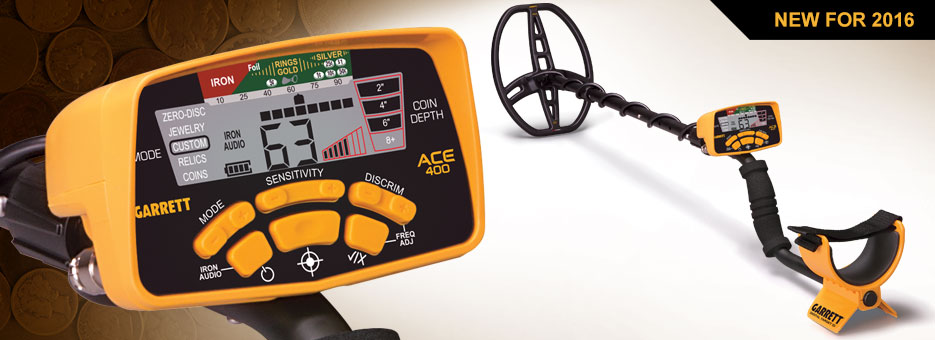
Ace 150 and 250
Comments:
Since 2004, the White’s Prizms were dominating the lower end
of the professional market. Garrett Electronics came out with the
Ace 250, which rivaled the White’s Prizm IV in terms of features
and performance. The Ace 250 offers more sensitivity and better
visual discrimination resolution than the $179.95 Ace 150. My
only complaint is the size of the screen… a bit TOO small
and hard on the eyes compared to the larger screens of the Prizm and
Fisher series. It should be noted that the Ace 150 actually comes
with a set of headphones… why not extend it to their more
expensive 250?
How about it, Garrett Electronics???
Price
Range: $400.00 to $900.00
White's
MXT and M6
Comments: The Prizm T6 with
advanced ground tracking, and so many features, you must see it to believe
it. Part of the secret to the Prizm's effectiveness is it's ultra-smooth
audio circuit and loud alert. And in March 2009 the new 4x6 shooter
search coil was introduced. Customer respone has been very favorable,
with reports of digging up dimes (smallest USA coin) at 9"! One
of my favorites with the highest fun factor in the metal detecting industry
in a detector under $700.00. The Prizms also enjoy compatibility with
the Jimmy Sierra Bigfoot. You can purchase a Bigfoot loop through
Big Valley
Metal Detectors.
White's
Prizm IV and V
Comments: Enjoying the same
lightweight feel and balance of the Prizm II and III but with added
features such as Tone ID. The Prizm V adds 8 tones and sports the 950
loop for some added area coverage and about 10% more signal on deep
coins. But you do lose some sensitivity on smaller targets, so I actually
like the 8" loop design. The Prizms also enjoy compatibility with the
Jimmy Sierra Bigfoot. You can purchase a Bigfoot loop through Big
Valley Metal Detectors.
White's
Prizm T6
Comments: The Prizm T6 with
advanced ground tracking, and so many features, you must see it to believe
it. Part of the secret to the Prizm's effectiveness is it's ultra-smooth
audio circuit and loud alert. And in March 2009 the new 4x6 shooter
search coil was introduced. Customer respone has been very favorable,
with reports of digging up dimes (smallest USA coin) at 9"! One
of my favorites with the highest fun factor in the metal detecting industry
in a detector under $700.00. The Prizms also enjoy compatibility with
the Jimmy Sierra Bigfoot. You can purchase a Bigfoot loop through
Big Valley
Metal Detectors.
Fisher
F4
Comments:
Fisher, acquired last year by First Texas, who during the previous year
hired one of the industry's BEST engineers, Dave Johnson, has hit yet
another homerun with the Fisher F4. Excellent visual discriminator,
easy to read and lightning fast target sampling. Seems to have the same
horsepower as the F2 but with more bells and whistles to supplement
an excellent circuit, including manual or auto position ground balance
and an all metal mode with auto tune position for prospecting. Visual
target ID scale adorns the top portion of the display with target pointer
and large digital numbers. Comes with the F75 10" wide scan loop AND
the 8" concentric for trashy areas. Big Valley considers the Fisher
F4 a BEST BUY
and BEST
performer in its category.
Garrett
1350 GTAx
Comments:
Since 2004, the Garrett 1350 GTAx came on the scene, replacing the GTAx
1250 and adding a sizing feature callined target profiling, which placed
the target into one of three size categories; A, B, C. The GTAx has
a well balanced feel and is light enough for most folks. Digital tone,
including Garrett's bell tone response. Full featured. Depth is above
average, as well as Garrett's visual discrimination and electronic pinpointing.
The rear battery compartment can pull off and hip mount, decreasing
the weight on your arm.
Minelab
X-Terra series
Comments: Since 2005. The X-Terra series have an extremely
light feel and operate at a standard frequency of 7.5 kHz with an ultra
quiet digital circuit. My first time out with the X-Terra 50 and first
target at Montara Beach was a white gold earring at about 7", easily
heard with the X-Terra's loud alert target response and wonderful tone
ID. The digital number display is about as easy as the Fisher F4's to
read, although the X-Terras are not quite as quick as the Tesoros or
Fishers on target sampling, The X-Terra 50/505, like the flagship X-Terra
70/705, can change frequency by changing the loops. The
X-Terra 50/505 can switch to 18+ kHz loop for superior audio response
on small gold targets and nuggets. X-Terra 50 has manual ground balance
control while the 30's ground balance point has been preset by the factory
to handle most conditions. The X-Terra 70 offers sophisticated automatic
ground tracking and additional programming AND a 10" loop that changes
the frequency to 3 kHz for outstanding target response on high conductive
silver targets. The updated 305, 505 and 705 do have updated softwae,
and react a little faster, generally speaking.
Tesoro
Vaquero
Comments: Tesoro's Vaquero operates at just under 15 kHz
with a 3 position frequency shifter to further avoid noisy cross talk
from other detectorists or powerlines. These are Umax detectors, which
makes them about the lightest in their performance class. The Vaquero
has a manual 3 3/4 ground balance, which works the all metal and discrimination
mode. The Vaquero's circuit is also found in the Cibola, which has its
ground balance point set internally by Tesoro.
Tesoro's
DeLeon, Cortes, & Tejon
Comments: All three share Tesoro's
lightning fast discriminator target sampling and lifetime warranty.
The DeLeon and Cortes (top dog in Tesoro's line-up) have visual target
ID, but the display is very small compared to other visual discriminators.
The Cortes also has a feature similar to White's Signagraph system,
but again, the visual lacks resolution, so dimes, quarters, halves,
and dollars read as 'COINS'. Tesoro's real strong point as always been
its analog audio response. Smooth targets that are coin size are always
worth digging and broken and/or harsh sounding targets are worth avoiding.
The Tesoro Tejon is Tesoro's deepest detector, operating at a 17.5 kHz.
This is a bit on the high side for silver hunting, but reports from
the field say that the Tejon is bringing in a lot of silver normally
masked by trash targets and unseen by the competition. The Tejon uses
a twin level discriminator that can be set in a variety of ways. I set
the higher level to barely pop on a zinc penny so I don't have to dig
them. Last time out with the Tejon, my associate dealer, Greg @ Trans
Bay Metal Detectors, scored a beautiful white gold wedding band in the
bark and is one of my favorites. Because of its higher frequency, the
Tejon is a bit more reactive over the small iron, but that can be a
positive as far as seeing through the nails etc. The all metal modes
on both the Vaquero and Tejon have a preset gain level, so the sensitivity
is really a stability gain control in the discrimination mode.
White's
M6 and MXT
Comments: With its 14.7 kHz frequency, and sharing
the same horsepower as MXT, the M6 adds seven tones of target ID in
addition to the highest visual resolution you can find in a metal detector,
190 segments. The MXT, considered by many as the BEST HYBRID
for serious electronic prospecting, relic hunting or coin and jewelry
hunting, offers additional features like separate programs that change
the visual display. The 3rd generation Dave Johnson engineered ground
tracking system is considered by many to be the best on the market.
My buddy Greg was given the assignment to test the prototype MXT with
various prototype chips in cooperation with White's technical engineering
staff. This culminated in a ground tracking system that set the standard
from 2004 to date. White's MXT continues to be one of the most popular
sellers at Big Valley Metal Detectors because of its ability to tackle
virtually ever surf and turf situation. The only drawback is that it
isn't is submersible, like some of the specialty detectors.
Minelab Sovereign GT
Comments: In 1990, Minelab, an Australian
based metal detecting company specializing in mine detecting technology,
came out with the first multi-frequency detector, the Sovereign. Rather
than a more traditional ground balance control, the Sovereign used BBS
or broad band multi-frequencies to filter out the ground reactivity
noise including hot rocks that could mimic targets. The Sovereign enjoyed
improvements in the Sovereign XS, the XSII, XS2a and Sovereign Elite.
In 2005, the Sovereign GT was introduced. It incorporated an all metal
mode with auto tune assist to extend deeper into the ground when prospecting
for gold nuggets. The Sovereign GT's active frequency is approx. 7 kHz
and is designed like the top of the line Explorer to be capable of being
swept ultra-slow without losing any of its maximum depth potential.
A visual 3 digit numerical display is a $100.00 option and compliments
the subtle target tone ID. Note: The submersible variant is the Excalibur
1000/II @ $1399.95.
White's
XLT
Comments: The XLT operates at White's traditional
6.59 kHz for very good response on silver conductive targets and good
response on most gold jewelry but it is not up to the performance of
the MXT on the lower conductors. The XLT shines in its Signagraph technology
and smooth operation as it is a full filtered detector. On a dime at
8" the XLT can deliver a better target signal than the MXT or M6, but
it requires a faster sweep speed to do so. The Signagraph technology
will not only read out the target ID but it will deliver 1 bar up on
round targets within 6" to surface. The XLT has been in the White's
line-up for over 10 years and was preceded by the Eagle Spectrum and
Eagle series (White's first digital detectors).No matter what you own,
the XLT can complement your collection.
Price
Range from about $1000.00
Fisher
F75
Comments: The Fisher F75, like the
F4 and F2, has outstanding features and performance. Operating at over
13 kHz, and with oodles of sensitivity, it can deliver on both high
and low conductors (Silver and Gold). This detector is like
a 327 Chevy engine with a hot cam and just street legal due to its high
gain circuit. Its automatic back light system for night time hunting
is the BEST I've experienced. Its depth is exceptional, but requires
proper tuning to ensure stable hunting. Great light weight and well
balanced feell in its category.
Minelab
Quattro and Explorer SE
Comments: Both are known as Silver
magnets. Both use FBS circuits or full band frequencies (28 actually),
Minelab's unique way to filter out negative ground and magnetic interference.
The active frequency may be about 3kHz and the other harmonics act in
concert to sample and neutralize ground noise and power lines. When
the noise is neutralized, your ability to hear the deeper targets is
enhanced. The 3 kHz will double the signal on deep silver vs other frequencies.
The output is digital, and although it the Explorer and Quattros make
it easier to hear that deep silver without having to tweak, your lower
conductors, gold and nickels and other jewelry, are usually ignored
by most of the Explorer-Quattro users. Foil, shards of aluminum and
crown caps sound a little too good, where competitor's circuits chop
those targets up. The Explorer has a tad bit more gain over the Quattro
and a smart find screen. I really like the Quattro's audio and visual
pinpointing system. They are lacking in the SE, which uses a more conventional
VCO pinpoint. Andy Sabisch has said that the Quattro seems to sniff
out the good targets better amongst the trash. Now this was when the
top of the line Explorer was the Explorer II, so most likely any advantage
the Quattro enjoyed became a part of the Explorer SE, which is said
to do better in trashy areas over the Explorer II. The Explorer series
began with the XS in 2000, then the II several years later and toward
the end of 2005, the SE. All in all, these are nice, deep metal detectors
and are great silver shooters.
White's
E Series DFX
Comments: When it comes to a do it all detector,
the DFX is one of the top dogs. Not only is it a multi-frequency detector
with 3 and 15 kHz, along with 18 other harmonic frequencies, but you
can select to operate in 3 kHz for silver or 15 kHz for gold. Along
with 55 basic and pro options you're in total control. The DFX, like
the XLT, offers Signagraph technology but in addition to that you can
adjust the sweep speeds, filters etc. The DFX comes standard with the
950 concentric loop, but my advice is to buy the optional 6x10" Eclipse
wide scan, which significantly improves visual target ID in all ground
conditions and gives improved target separation.
Garrett
GTI 2500
Comments: Bells and whistles, good
depth but long in the tooth and on the heavy side. Garrett GTI 2500
offers a wide screen and although not as sophisticated as the other
big dog competition, it does offer sizing technology A through E. Most
coins and jewelry fall out in the B, with man hole covers in the E size
along with some caches, I guess. This detector actually can be programmed
to talk to you using a female voice. A poster on one of the the forums,
who is a single bachelor, actually put it on voice mode and slept with
his GTI 2500... now that's love. Depth is above average for a single
frequency detector at approximately 7 kHz and seems sensitive enough
for gold rings. Ground tracks in the all metal mode. I suspect that
the discrimination mode and ground balance point is automated in the
chipand cannot be manually manipulated.
And
last, but not least!
White's
V3
Comments: over seven years of R&D brings you the
industry's most advanced flagship. Unsurpassed
in audio, visuals, brute power and selectivity, conceived with
advanced circuitry- and wireless headphone technology:
Three active frequencies,
analysis mode (shape, size, response), color screen, and many more surprises!!!
30%+ deeper than other E series detectors, taking you to a new level.

Questions?
Call Larry
at (916) 225-9150
larry@bigvalleymetaldetectors.com
Minelab
Garrett
Tesoro
Fisher
SunRay
RaTphones
Bounty Hunter
Security scanners
Angus McKirk Prospecting
Quality recovery tools, Lesche, Apex
|
|
"Site
to Site, Season to Season"
Big
Valley never sleeps while its customers are awake!
Located
in Citrus Heights, California,
we are an easy drive from Sacramento, Fair Oaks, Roseville, Rocklin,
Orangevale, Folsom, Carmichael, Citrus Heights, Loomis, Placerville,
Woodland, Davis, Granite Bay, Cameron Park, El Dorado Hills, Elk Grove,
Auburn, Marysville, Dixon, Yuba City, Lodi, Stockton, Galt and many
more places. Call for directions!
Last
updated 11 December, 2009 by the rogue webmistress.... |